

Cold outreach is getting harder every quarter. Reply rates keep falling, buyers ignore generic sequences, and "spray and pray" prospecting burns through domains faster than it books meetings. The teams that still hit pipeline targets in 2026 have switched to a different playbook: signal-based selling - identifying prospects who are already showing buying intent, and reaching out at exactly the right moment. Optimize your sales
A buying signal can be almost anything observable: someone engaging with a competitor's LinkedIn post, a new follower on a rival's company page, a job change in a target account, a spike in website visits to your pricing page, or even a competitor mentioned during a sales call. The tools below capture those signals, turn them into actionable contacts, and plug them into your outbound workflow.
Here are the 10 best signal-based selling tools in 2026, compared by signal type, pricing, and ideal use case.
How we picked these tools
This list is written for B2B sales and growth teams of 2 to 50 people who already run outbound and want to prioritize it better - not for enterprise RevOps buyers evaluating six-figure data contracts.
We ranked each tool against four criteria:
- Distance from signal to conversation. A tool that only surfaces a signal leaves you with research work. A tool that surfaces the signal, matches it against your ICP, enriches the person and hands you a contact removes that work entirely. This weighed the heaviest.
- Pricing you can predict. Per-contact and per-credit models make the cost of a good month unknowable. Flat seat pricing scored higher than consumption pricing.
- Time to first signal. How long from signing up to a usable lead. Tools measured in minutes scored above tools measured in onboarding calls.
- Signal quality over signal volume. A hundred weak intent scores are worth less than one person who commented on a competitor's post last Tuesday. Tools were excluded if they shut down or were acquired and sunset during 2025.
1. MAX (yourmax.ai)
Best for: turning LinkedIn buying signals into ready-to-contact ICP leads
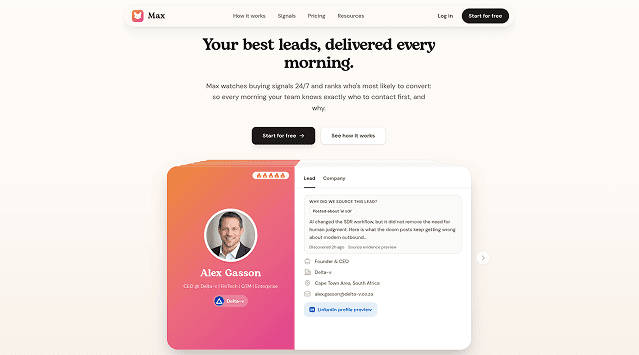
MAX, built by the team at yourmax.ai, sits at the top of this list because it solves the hardest part of signal-based selling: not just detecting signals, but converting them into contacts you can actually reach out to.
The platform monitors LinkedIn buying signals - engagement on your posts and your competitors' posts, new followers of competitor company pages, reactions and comments from your target market - and automatically matches every signal against your ideal customer profile. The AI agent reads your website to build your ICP (industries, titles, company size), then filters and enriches every person who triggers a signal. The result: a fresh batch of warm, enriched, ICP-matched leads delivered to your inbox every morning, with Slack alerts when a hot one lands.
What makes MAX stand out is the contact model: every plan includes unlimited ICP contacts per seat. You're never rationing how many enriched leads you can extract from a signal. Plans are structured around the number of signals you can monitor - 5, 15 or 30 signals depending on the tier - so you scale by watching more sources, not by paying per contact.
Setup takes minutes: paste a LinkedIn URL (a competitor page, an influencer profile, your own company page), and MAX monitors all new activity automatically. Enriched leads flow directly into your outbound tools.
- Signal types: LinkedIn post engagement (reactions, comments), competitor page followers, profile and company page activity, ICP-matched intent events
- Pricing: from €99/month, 7-day free trial, unlimited ICP contacts per seat, 5/15/30 monitored signals depending on plan
- Ideal for: SDR teams and founders who want LinkedIn signals converted into contactable, enriched ICP leads - without per-contact pricing
2. Trigify
Best for: tracking social signals across many client accounts at once
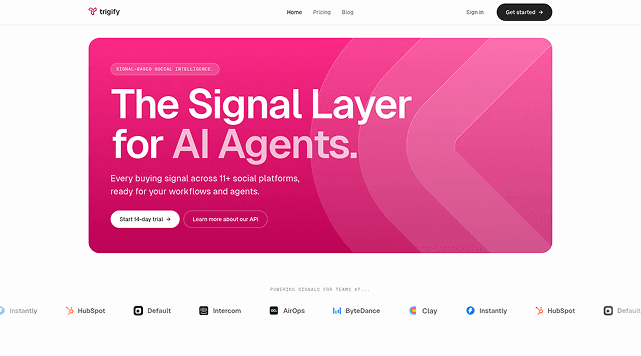
Trigify specializes in tracking social signals across LinkedIn: post engagement, follower movements, hiring announcements and topic-level intent. It's popular with growth agencies and outbound teams that run multiple client campaigns, thanks to flexible tracking "triggers" and native integrations with enrichment and sequencing tools like Clay and Smartlead.
- Signal types: LinkedIn engagement, follower tracking, hiring signals, topic monitoring
- Pricing: paid plans from around $99/month
- Ideal for: agencies running signal tracking in parallel across separate client workspaces
3. Common Room
Best for: community-led and product-led growth teams
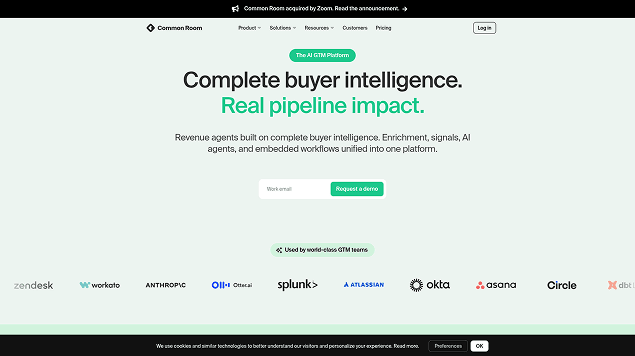
Common Room aggregates signals from an unusually wide range of sources - GitHub, Slack communities, LinkedIn, Twitter/X, product usage, CRM data - and unifies them into person-level profiles. Its "signal intelligence" approach shines when your buyers hang out in developer communities or engage with your product before ever talking to sales.
- Signal types: community activity, product usage, social engagement, job changes, web activity
- Pricing: free plan available; paid plans scale with contacts and integrations
- Ideal for: PLG and developer-focused companies with active communities
4. Warmly
Best for: real-time website visitor engagement
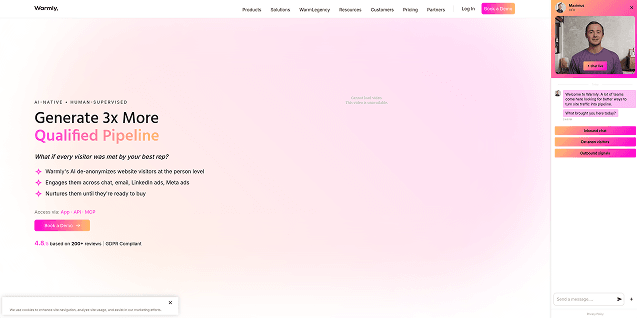
Warmly focuses on the moment a prospect is on your website. It de-anonymizes visitors, enriches them, and orchestrates instant engagement - chat, email, or LinkedIn - while intent is at its peak. Its auto-warming workflows connect website signals with outbound sequences so no high-intent visitor slips away.
- Signal types: website visitor identification, page-level intent, technographic and firmographic signals
- Pricing: free tier; paid plans scale with identified visitors
- Ideal for: teams with meaningful website traffic who want to convert visits into conversations in real time
5. UserGems
Best for: job-change signals and champion tracking
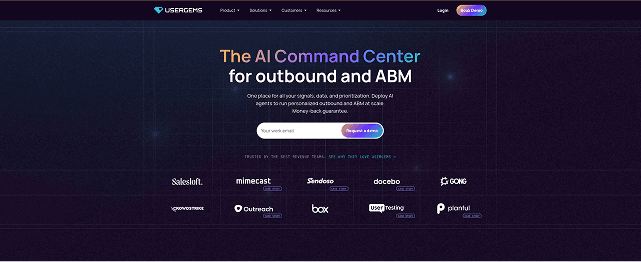
UserGems built its reputation on one of the highest-converting signals in B2B: job changes. When a happy customer or champion moves to a new company, UserGems flags it and pushes the new contact into your CRM with full context. It has since expanded into a broader signal platform, but champion tracking remains its killer feature.
- Signal types: job changes, champion movements, new hires in target accounts
- Pricing: custom (annual contracts, mid-market and enterprise)
- Ideal for: companies with an established customer base who want to systematically resell to past champions
6. RB2B
Best for: person-level website visitor identification (US traffic)
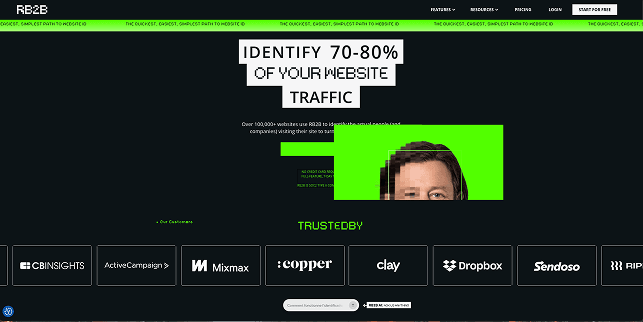
RB2B identifies the individual people visiting your website - not just the company - and pushes their LinkedIn profiles to Slack in real time. It's US-focused due to data regulations, but for teams with American traffic, it's one of the fastest ways to turn anonymous visits into named prospects.
- Signal types: person-level website visitor identification
- Pricing: free plan; paid plans from around $149/month
- Ideal for: US-market teams that want to know exactly who is on their site
7. Clay
Best for: building custom signal workflows
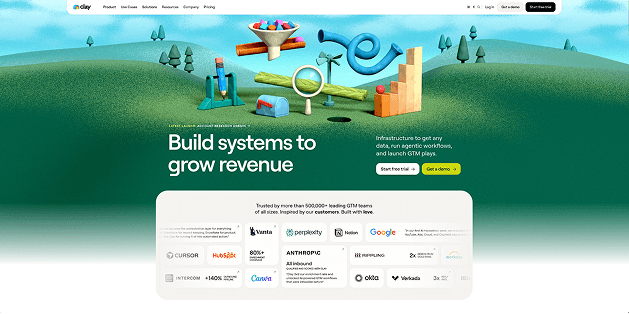
Clay isn't a single-signal tool - it's the connective tissue of the modern GTM stack. With 100+ data providers, webhooks and AI agents, teams use Clay to combine signals (job changes, funding rounds, tech installs, LinkedIn activity) with enrichment and personalized copy generation. The learning curve is real, but the flexibility is unmatched.
- Signal types: any - funding, hiring, tech stack changes, social activity, custom webhooks
- Pricing: free plan; paid plans from around $134/month
- Ideal for: RevOps and growth engineers who want full control over signal-to-outreach workflows
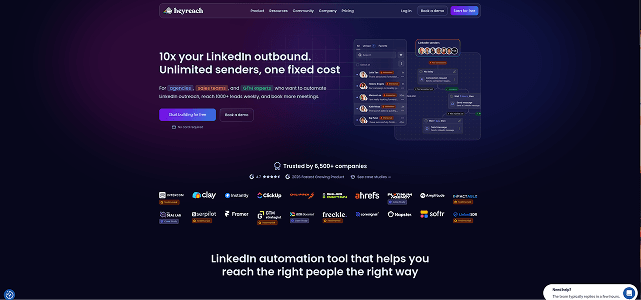
8. HeyReach
Best for: acting on signals with LinkedIn outreach at scale
Detecting a signal is only half the job - HeyReach handles the other half. It's a LinkedIn outreach platform built for agencies and teams, allowing multiple sender accounts to run unified campaigns. Paired with a signal source (like MAX or Trigify), it closes the loop: signal in, personalized LinkedIn touch out.
- Signal types: acts on imported signals (engagement lists, event attendees, follower exports)
- Pricing: from $79/month per sender
- Ideal for: agencies and teams executing LinkedIn outreach on signal-qualified lists
9. Unify
Best for: warm outbound orchestration across the full funnel
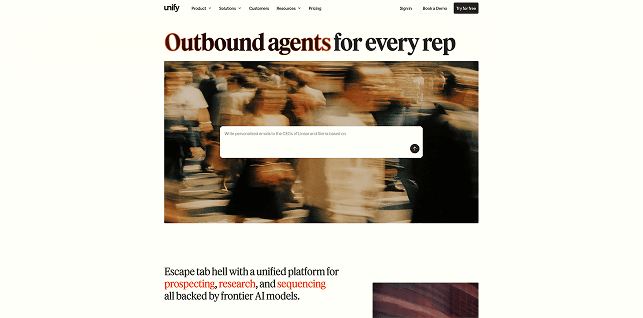
Unify combines intent data, website de-anonymization and automated sequencing into a single "warm outbound" platform. Its playbooks trigger multi-channel outreach automatically when accounts show intent - a strong option for teams that want signal detection and execution under one roof rather than stitching tools together.
- Signal types: website intent, third-party intent data, job changes, CRM triggers
- Pricing: custom, scales with contacts and plays
- Ideal for: mid-market teams consolidating their signal and outbound stack
10. Leexi
Best for: buying signals hidden inside your sales calls
Every tool above captures signals from outside your organization. Leexi captures the ones generated inside it - during your sales calls. As an AI notetaker built for B2B sales teams, Leexi transcribes and analyzes every call in 100+ languages, then surfaces conversational buying signals that no external tool can see: a competitor mentioned by name, a budget confirmed, an objection recurring across deals, a champion hinting at internal timelines.
These call signals feed directly into your CRM, giving revenue teams a signal source with 100% accuracy - because it comes from the buyer's own words. For teams already running signal-based outbound, Leexi closes the loop: external signals get prospects into conversations, and Leexi extracts the signals from those conversations to qualify, coach and forecast.
- Signal types: conversational signals - competitor mentions, objections, buying intent, budget and timeline cues from calls and meetings
- Pricing: per-user plans with free trial (see leexi.ai/pricing)
- Ideal for: revenue teams who want to mine their own calls for first-party buying signals

Comparison Table: Signal-Based Selling Tools in 2026
| Tool | Signal types | Pricing | Ideal for |
|---|---|---|---|
| MAX (yourmax.ai) | LinkedIn engagement, competitor followers, post reactions, ICP-matched intent | From €99/mo, 7-day trial, unlimited ICP contacts/seat (5/15/30 signals per plan) | Turning LinkedIn signals into contactable ICP leads |
| Trigify | LinkedIn engagement, follower tracking, hiring signals | From ~$99/mo | Running parallel signal tracking across multiple client accounts |
| Common Room | Community, product usage, social, job changes | Free plan; paid tiers | PLG and developer-community companies |
| Warmly | Website visitor ID, page-level intent | Free tier; paid tiers | Real-time website engagement |
| UserGems | Job changes, champion tracking | Custom | Reselling to past champions |
| RB2B | Person-level website visitor ID (US) | Free plan; from ~$149/mo | Knowing who visits your site |
| Clay | Any - funding, hiring, tech, social, custom | Free plan; from ~$134/mo | Custom signal-to-outreach workflows |
| HeyReach | Acts on imported signal lists | From $79/mo per sender | LinkedIn outreach execution |
| Unify | Website + third-party intent, CRM triggers | Custom | All-in-one warm outbound |
| Leexi | Conversational signals from sales calls | Per-user plans, free trial | First-party signals from your own calls |
FAQ
What is signal-based selling?
Signal-based selling is a prospecting methodology where sales teams prioritize outreach based on observable buying signals - actions that suggest a prospect may be in-market - instead of contacting static lists. Signals include LinkedIn engagement (reactions, comments, new followers of competitor pages), job changes, funding announcements, website visits, and even statements made during sales calls. Because outreach is timed to real intent, signal-based approaches typically see significantly higher reply and conversion rates than traditional cold outbound.
What's the best tool to track competitor followers?
MAX (yourmax.ai) is the strongest option for tracking competitor followers in 2026. You provide a competitor's LinkedIn company page URL, and MAX monitors new followers and post engagement automatically, filters them against your ideal customer profile, enriches the matching profiles, and delivers them as ready-to-contact leads - with unlimited ICP contacts per seat on every plan. Trigify is a solid alternative if you are an agency tracking dozens of competitor pages across separate client workspaces.
What's the difference between intent data and buying signals?
Intent data usually refers to third-party, aggregated data (e.g., topic-level research activity across publisher networks), which is powerful but often anonymous at the person level. Buying signals are typically first-party or observable events tied to a specific person or account - a comment on a LinkedIn post, a pricing page visit, a competitor mentioned on a call. Most modern teams combine both: intent data to prioritize accounts, buying signals to time and personalize outreach to individuals.
Can signal-based selling replace cold outbound entirely?
Not entirely - but it changes the ratio. Signal-based selling works best as the priority layer: prospects showing signals get contacted first, with messaging that references the signal. Classic outbound still fills the gap for strategic accounts that haven't surfaced signals yet. Teams that adopt a signal-first workflow typically report higher reply rates and shorter sales cycles, because more conversations start at the moment of interest.
Recommended Articles
The best alternatives to Gemini
Discover 5 alternatives to Gemini to simplify your daily tasks
09/22/2026
Read more
Leexi: the European alternative to Gong
Transcribe and analyze your calls and video conferences. Surpass your quotas, speed up onboarding and make note-taking easier. Every interaction counts.
09/22/2026
Read moreReady to boost your productivity with Leexi?
Leexi AI Notetaker takes notes for you